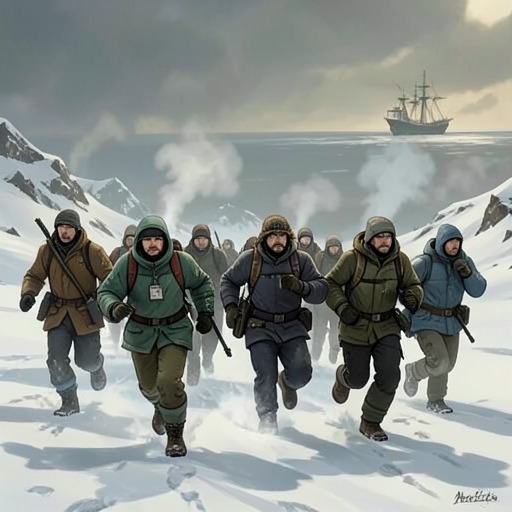
Rachel signals for help to underwater listening equipment with an ice pick
Deception PointRachel Sexton signals for help to underwater listening equipment with an ice pick in a pivotal act of witness: stranded on the ice, she turns an ice ax into a crude transmitter so the evidence of a concealed meteorite insertion may survive even if she does not. The signal is not chiefly a plea to save the people on the iceberg. It is a deliberate attempt to make sure the truth reaches the National Reconnaissance Office.
Circumstances and Purpose
Rachel acts after concluding that she and Michael Tolland are unlikely to survive the situation on the Milne Ice Shelf. She suspects NASA administrator Lawrence Ekstrom may be implicated in the attack, but she does not know who arranged for the meteorite to be placed beneath the ice or why. Meanwhile, President Zachary Herney is approaching a White House announcement of the discovery, relying on a video documentary and endorsements from four civilian scientists. Rachel believes the announcement rests on false data, and that the effort to expose the fraud cannot wait for her own rescue.
Her immediate purpose is to get the GPR printout in her pocket into the hands of the National Reconnaissance Office. The printout records the evidence that a tunnel was inserted beneath the meteorite. If that evidence disappears with the stranded investigators, the discovery’s hidden construction may remain concealed. Rachel therefore redirects her final effort from survival toward transmission: the signal is meant to carry information beyond the iceberg.
The Signal on the Ice
Despite her pain and weakness, Rachel pulls herself upright on the flat ice and finds the ice ax still secured to her belt. She turns it upside down and strikes its butt against the ice in a steady, repeated pattern. Michael Tolland watches in confusion and tries to speak to her, but Rachel does not answer; she needs to conserve her strength for the blows.
Tolland’s knowledge as an oceanographer helps him recognize that she is trying to contact underwater listeners. Rachel is not relying on the Suboceanic Acoustic Array, whose network of fifty-nine underwater microphones listens for whales across much of the world’s oceans but does not cover this remote part of the Arctic. She believes other listening systems may be monitoring the ocean floor. Her repeated strikes are thus shaped by a specific gap in the known network and by her conviction that less publicized listeners may still hear them.
The narrative renders the action as a sequence of blows rather than as a conventional spoken message. Rachel’s pattern is clear in its repetition, even as the people around her cannot know whether anyone will receive it. The ice ax becomes both a tool at hand and the means by which she converts a bodily gesture into a possible transmission.
Evidence, Rescue, and the National Reconnaissance Office
Rachel does not mistake the signal for a likely rescue call. She doubts she has even half an hour left and understands that immediate rescue is beyond possibility. The distinction matters: her act is not driven by confidence that the people on the ice will be saved, but by the hope that evidence will survive them.
She expects the National Reconnaissance Office’s listening network, known as Classic Wizard, to detect the abnormal sequence. Replacing the older Suboceanic Acoustic Array in the mid-1980s, Classic Wizard is described as thirty times more powerful and as providing total global coverage. Rachel imagines the system’s supercomputers at the National Reconnaissance Office and National Security Agency listening post at Menwith Hill, England, flagging an anomalous Arctic hydrophone pattern, decoding it as an SOS, and triangulating its source. In that anticipated chain of events, a rescue plane dispatched from Thule Air Force Base would find the three people on an iceberg, with Rachel carrying the GPR printout.
The expected rescue comes too late to promise survival: Rachel pictures the plane finding the three bodies frozen. Yet the imagined discovery of the printout would still matter. Once examined, it would reveal the mysterious insertion tunnel beneath the meteorite. Rachel cannot know what investigators would do next, but she believes the evidence would prevent the secret from dying with them.
Consequences and Significance
The signaling attempt joins a physical emergency to a larger crisis of public information. Herney has announced that he will reveal the discovery at a White House press conference; later, Rachel urgently tells Marjorie Tench that the meteorite data are wrong because the object was inserted from beneath the ice shelf. Rachel’s blows on the ice belong to the same struggle over who will learn the truth, but operate through a starkly different channel: not an official briefing or broadcast, but a pattern sent toward hidden instruments beneath the Arctic.
That contrast gives the action its decisive significance. The White House Communications Office can distribute a presidential announcement through fax, email, telephone, websites, and live television feeds, while Rachel’s evidence depends on a signal that may or may not be heard. The announced discovery has the reach and authority of a public spectacle; the truth, at this moment, depends on a stranded investigator, an ice ax, a hydrophone, and a piece of thermal paper.
Rachel’s choice also marks a shift in the meaning of rescue. She does not abandon the possibility that her signal could prompt a response, but she refuses to make her own survival its measure of success. If the printout reaches the National Reconnaissance Office, others may uncover the insertion even after the people who found it are gone. Her final blows therefore function as both a possible SOS and an act of testimony: the first may fail, but the second can still outlast her.